



Do garbage bags on roll resist punctures well?
As a supplier of garbage bags on roll, I've been asked this question numerous times. The ability of a garbage bag to resist punctures is crucial, as it directly impacts its functionality and user experience. In this blog, I'll delve into the factors that determine the puncture resistance of garbage bags on roll and share some insights based on our products and industry knowledge.
Understanding Puncture Resistance
Puncture resistance refers to a material's ability to withstand the force of a sharp object without tearing or breaking. In the context of garbage bags, it means that the bag can hold items with sharp edges or points, such as broken glass, metal cans, or jagged plastic, without leaking or splitting. This is important not only for containing waste safely but also for preventing damage to the environment and potential injuries to handlers.
Factors Affecting Puncture Resistance
Several factors contribute to the puncture resistance of garbage bags on roll. Let's take a closer look at each of them:
Material Quality
The type of material used to make the garbage bag is the most significant factor in determining its puncture resistance. High - quality materials are more likely to resist punctures. For example, our garbage bags on roll are often made from high - density polyethylene (HDPE) or linear low - density polyethylene (LLDPE). HDPE is known for its stiffness and strength, which provides good puncture resistance. LLDPE, on the other hand, offers excellent flexibility and toughness, making it less likely to tear when subjected to sharp objects.
Thickness
The thickness of the garbage bag is another crucial factor. Generally, thicker bags are more puncture - resistant. Our garbage bags on roll come in various thicknesses, allowing customers to choose the one that suits their specific needs. Thicker bags are ideal for heavy or sharp waste, while thinner ones can be used for lighter loads. However, it's important to note that thickness is not the only determinant of puncture resistance; the quality of the material also plays a vital role.
Manufacturing Process
The way the garbage bag is manufactured can also affect its puncture resistance. A well - made bag with uniform thickness and proper sealing is more likely to resist punctures. Our manufacturing process ensures that each garbage bag on roll is produced with precision, minimizing weak spots and ensuring consistent quality. We use advanced techniques to create strong seams and edges, which helps to prevent tears and punctures.
Design Features
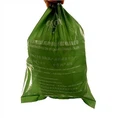
Some garbage bags on roll come with design features that enhance puncture resistance. For example, our Drawstring Garbage Bag has a reinforced drawstring that not only makes it easy to close but also adds an extra layer of strength around the top of the bag. Additionally, some of our bags have a textured surface, which can help to distribute the force of a sharp object over a larger area, reducing the risk of puncture.
Testing Puncture Resistance
To ensure the quality of our garbage bags on roll, we conduct rigorous testing to measure their puncture resistance. We use industry - standard testing methods, such as the ASTM D1709 dart drop test. In this test, a weighted dart is dropped onto the bag from a specific height, and the bag's ability to withstand the impact without puncturing is measured. We also perform real - world testing by filling the bags with various types of waste, including sharp and heavy items, to simulate actual usage scenarios.
Comparing Different Types of Garbage Bags
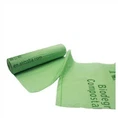
In addition to our traditional garbage bags on roll, we also offer PLA Garbage Bags and Biodegradable Cornstarch Bags. These eco - friendly alternatives are made from renewable resources and are designed to break down naturally over time. While they are generally more environmentally friendly, their puncture resistance may vary compared to traditional plastic bags.
PLA (polylactic acid) is a biodegradable polymer made from renewable resources such as corn starch. Our PLA garbage bags are designed to have good strength and flexibility, but their puncture resistance may be slightly lower than that of HDPE or LLDPE bags. However, they are still suitable for most household waste, especially lighter loads.
Biodegradable cornstarch bags are also a popular choice for those looking for an eco - friendly option. These bags are made primarily from cornstarch and other natural materials. They offer a decent level of puncture resistance, but again, they may not be as durable as traditional plastic bags when it comes to heavy or sharp waste.
Practical Tips for Using Garbage Bags to Maximize Puncture Resistance
Even with high - quality garbage bags on roll, there are some practical tips you can follow to maximize their puncture resistance:


- Pre - wrap sharp objects: Before placing sharp items in the garbage bag, wrap them in newspaper or a soft cloth to reduce the risk of puncture.
- Avoid overloading: Do not overfill the garbage bag, as this can put excessive stress on the bag and increase the likelihood of puncture.
- Use double - bagging: For especially heavy or sharp waste, consider using two garbage bags on roll. This provides an extra layer of protection.
Conclusion
In conclusion, garbage bags on roll can resist punctures well if they are made from high - quality materials, have an appropriate thickness, are well - manufactured, and may have design features that enhance puncture resistance. As a supplier, we are committed to providing our customers with garbage bags on roll that meet the highest standards of quality and performance. Whether you need a traditional plastic bag or an eco - friendly alternative, we have a solution for you.
If you're interested in learning more about our garbage bags on roll or would like to discuss your specific requirements, we encourage you to contact us for a procurement discussion. We look forward to working with you to find the perfect garbage bag solution for your needs.
References
- ASTM International. (Year). ASTM D1709 - Standard Test Methods for Dart - Impact Resistance of Plastic Film by the Free - Falling Dart Method.
- Plastic Bag Manufacturers Association. (Year). Guide to Understanding Plastic Bag Materials and Properties.